
In this blog post, Dr. Georgios Arseniou writes about his fractal dimension of trees research and management applications for urban and community forestry. Read Dr. Arseniou’s previous blog post here.
In my research I focus on the biophysical aspect of urban forestry and more specifically the structure and function of urban trees affected by human infrastructure. In my previous work I have used a metric called “fractal dimension” to quantify and describe tree architecture. In geometry, fractal objects are self-similar objects across different scales and their dimension is a fractional number (e.g., snowflakes have a fractal architecture).
Leonardo da Vinci was the first who argued that trees have a fractal-like architecture due to the repetitive growth pattern of their branches. Important theories in tree biology (e.g., the pipe-model theory and the metabolic scaling theory) assume that the branches of trees have a fractal architecture. However, trees should be treated as “disrupted” fractals because competition for light reduces their inherent fractal character. Therefore, open-grown urban trees that typically face no or reduced competition for sunlight should have more evident self-similar architecture compared to rural forest trees.
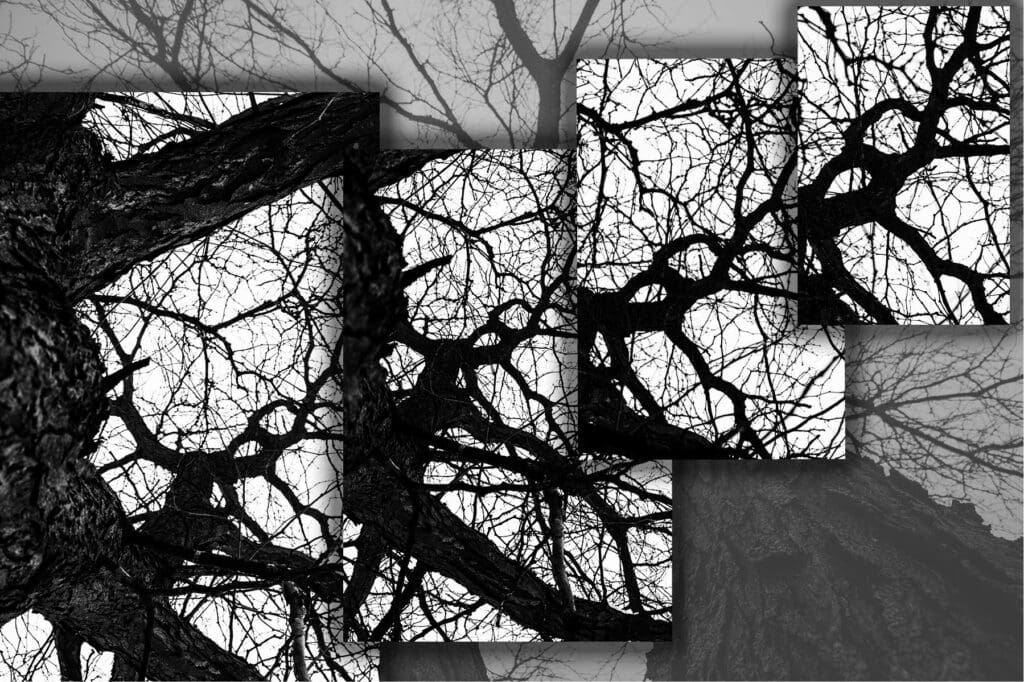
There are different ways to quantify the fractal dimension of trees. In a previous study, we used a variation of the “two-surface-method” which treats the crown of trees as a sponge, and it measures fractal dimension by quantifying the distribution of leaf surface area within the crown volume of a tree. According to this method the fractal dimension takes values between 2 and 3. Values close to two indicate reduced fractal dimension (more like a flat Euclidean surface) because the foliage is mostly distributed on the crown periphery, whereas values close to 3 indicate increased fractal dimension (more like a sponge) because the foliage is more evenly distributed within the crown volume. In our study we analyzed the crown fractal dimension of thousands of urban trees across the United States based on a publicly available database (McPherson et al. 2016).
It was very interesting that we found a strong negative relationship between the drought tolerance of urban tree species and their fractal dimension. We also found a strong negative relationship between leaf mass per unit area and the fractal dimension of all studied urban tree species. These results indicate that drought-tolerant species—e.g., honey locust (Gleditsia triacanthos)—have thicker leaves which are distributed mainly on the crown periphery. This is most likely to reduce the amount of water vapor lost through transpiration due to relatively increased atmospheric temperatures in cities.
It appears difficult to build a crown structure that can cast a deep shade while also trying to reduce fractal dimension to reduce water loss. These findings have important management implications, because it means that drought-tolerant species which are well suited for the relatively increased atmospheric temperatures in cities have reduced fractal dimension and may provide less shade. On the other hand, species that are not very drought tolerant have increased fractal dimension and can provide deep shade. However, they need to be watered more often which means increased maintenance costs, particularly for cities with warm and arid climates such as those in the southern U.S.

The fractal dimension of trees also relates to their vigor considering different stressors that trees face in urban settings. This study showed that trees growing close to buildings (up to 8 meters/26.2 feet) had reduced fractal dimension most likely due to limited growing space, large amount of impermeable (concrete) surfaces and due to the increased local atmospheric temperature from the heating and cooling systems of buildings.
Furthermore, it was found that land use also affects tree fractal dimension. Trees growing in heavily urbanized areas (e.g., industrial and commercial settings, transportation corridors, etc.) had reduced fractal dimension, most likely due to the unfavorable growing conditions. Conversely, trees in open park areas and residential areas had increased fractal because they had more available growing space and they probably received more care from groups of residents, something that highlights the sociological factors that may affect tree growth and survival in cities.
Finally, trees growing near utility wires also had reduced fractal dimension, most likely due to tree pruning and trimming to prevent conflicts. All these results highlight the importance of studying the architecture of urban trees in relation to their ecophysiology, their vigor, and the benefits that they provide—all having important implications for urban forest management.

Dr. Georgios Arseniou is an Assistant Professor & Extension Specialist of Urban Forestry at Auburn University & the Alabama Cooperative Extension System in Auburn, Alabama. He has a PhD in Forestry (2021) from Michigan State University, where his research used novel terrestrial laser scanning technology to model urban forest growth, urban forest biomass and structural complexity (specifically: fractal dimension), and wood properties of urban trees.
Citations
- Arseniou, G. & MacFarlane, D.W. (2021) Fractal dimension of tree crowns explains species functional-trait responses to urban environments at different scales. Ecological Applications, DOI: 10.1002/EAP.2297.
- McPherson, E.G., Van Doorn, N.S. & Peper, P.J. (2016) Urban tree database. Fort Collins, CO: Forest Service Research Data Archive. https://doi.org/10.2737/RDS-2016-0005.